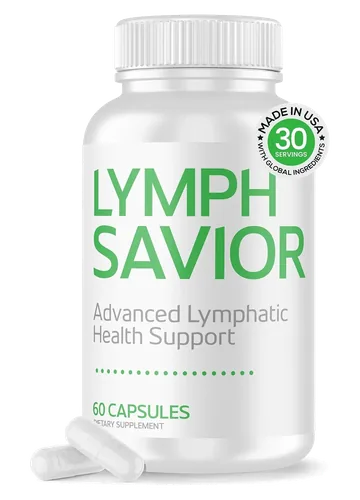
The formula
Lymph Savior Ingredients: All 10 Botanicals Listed
Lymph Savior is built on 10 botanicals.
The seller names six: red clover, horse chestnut seed, red root, Centella asiatica, burdock root and yerba mate. Brand graphics add ginger, echinacea, olive leaf and cleavers. No amounts are published.
All 10
What ingredients are in Lymph Savior?
Lymph Savior is made around 10 plant ingredients. The seller names six of them in its product brief, and brand graphics show four more.
Use the filter buttons to split the list. "Named by seller" means the plant appears in the seller's written ingredient list. "Brand graphic only" means we saw it in marketing art but not in that list.
- n/pRed Clover Extract (leaves and flowers)Named by seller
- n/pHorse Chestnut Extract (Aesculus hippocastanum) (seed)Named by seller
- n/pRed Root Powder (Ceanothus americanus)Named by seller
- n/pCentella asiatica Extract (aerial parts)Named by seller
- n/pBurdock Powder (root)Named by seller
- n/pYerba Mate Extract (Ilex paraguariensis) (leaves)Named by seller
- n/pGinger RootBrand graphic only
- n/pEchinaceaBrand graphic only
- n/pOlive LeafBrand graphic only
- n/pCleavers (Galium aparine)Brand graphic only
"n/p" means not published: no amount was supplied for any ingredient.
Each chip reads "n/p" because no Supplement Facts panel came with the product files. The full label story, with serving math, is on the Lymph Savior Supplement Facts breakdown.
Brand art
What do the Lymph Savior ingredient graphics show?
Two brand graphics picture the plants. Together they show nine of the 10 botanicals, and neither one shows red root.
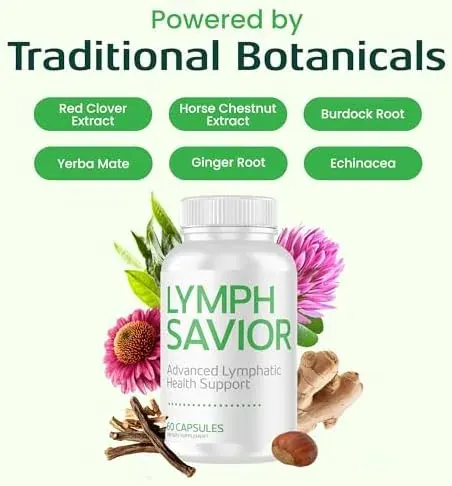
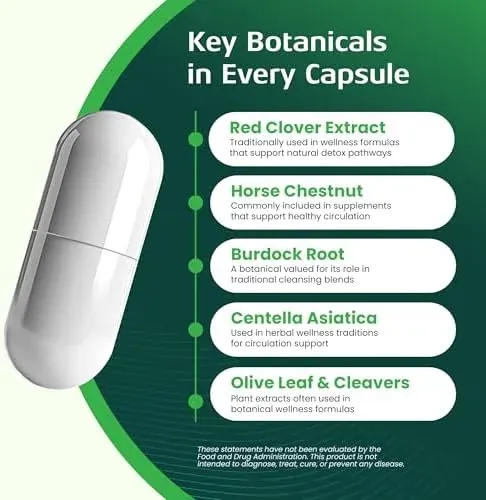
The second graphic uses the words "in every capsule." Without the label panel, we cannot check that line for olive leaf and cleavers. Red root shows up only in the written brief.
Named by the seller
Which six Lymph Savior ingredients does the seller name?
Red clover, horse chestnut, red root, Centella asiatica, burdock and yerba mate. Each card covers the plant, its traditional use and the human research.
Red clover extract
Red clover is a meadow plant in the pea family. The extract uses its leaves and flowers. Folk herbalists brewed the blossoms into teas. It holds isoflavones, plant compounds that act a little like estrogen. Human trials looked at hot flashes, with mixed results (NCCIH, Red clover). None looked at lymph.
Horse chestnut seed extract
This comes from the seed of the Aesculus hippocastanum tree. Its main compound group is called escin. European folk medicine used it for tired, heavy legs. A Cochrane review found less leg pain and leg volume in people with chronic venous insufficiency (Pittler & Ernst, 2012). Most trials used about 100 mg of escin a day (Underland et al., 2012).
Red root powder
Red root (Ceanothus americanus) is a North American shrub, also called New Jersey tea. Modern herbalists often put the root in lymph blends. The only study we found is from 1958. It tested red root bark compounds in rat blood, not in people (Lynch et al., 1958).
Centella asiatica extract
Centella, also sold as gotu kola, is a low creeping herb from wet ground in Asia. The extract uses the parts above the soil. Traditional Asian medicine used it for circulation and skin. We found no human trials on lymph flow. The NIH LiverTox database keeps a file on it (LiverTox, Centella).
Burdock root powder
Burdock is a large weed with a long taproot. In Japan the root is eaten as a vegetable called gobo. Brand graphics say it is "valued for its role in traditional cleansing blends." Memorial Sloan Kettering finds no evidence that burdock treats any medical condition (MSK, Burdock).
Yerba mate extract
Yerba mate (Ilex paraguariensis) is a South American holly. People there brew its leaves as a daily drink. The leaves carry caffeine at levels close to tea and coffee (LiverTox, Yerba mate). We found no research on yerba mate and the lymphatic system.
Brand graphics only
Which Lymph Savior ingredients appear only in brand graphics?
Ginger root, echinacea, olive leaf and cleavers. They are pictured in the art but missing from the seller's written list.
Ginger root
Ginger is the familiar kitchen spice root. Cooks and folk healers have long used it for an upset stomach. Human studies suggest it may ease nausea, including nausea in pregnancy (NCCIH, Ginger). No study tied ginger to lymph flow.
Echinacea
Echinacea, or purple coneflower, is a prairie flower in the daisy family. Plains tribes used it as a wound and cold remedy. Reviews say it may slightly reduce the chance of catching a cold (NCCIH, Echinacea). It has no lymph research.
Olive leaf
Olive leaf extract comes from the leaves of the olive tree. In one trial, 500 mg twice a day for 8 weeks lowered systolic blood pressure by about 11.5 mmHg in people with stage-1 hypertension (Susalit et al., 2011). That trial did not measure lymph or swelling.
Cleavers
Cleavers (Galium aparine) is a sticky climbing weed that clings to clothes. Herbalists used it as a spring tonic tea. The only research we found is one cell-culture study (Ilina et al., 2020). There are no human studies.
At a glance
Where does each Lymph Savior ingredient come from, and how strong is the evidence?
The table lists the plant part, whether the seller names it, and the best human evidence we found. Horse chestnut is the only row with a review of human trials.
| Ingredient | Plant part | Where it is listed | Best human evidence |
|---|---|---|---|
| Horse chestnut extract | Seed | Named by seller | Review of human trials (leg veins) (Pittler & Ernst, 2012) |
| Red clover extract | Leaves and flowers | Named by seller | Small or mixed trials (hot flashes) (NCCIH, Red clover) |
| Centella asiatica extract | Aerial parts | Named by seller | Traditional use only |
| Burdock powder | Root | Named by seller | Traditional use only |
| Yerba mate extract | Leaves | Named by seller | Caffeine source; no lymph research |
| Red root powder | Not published | Named by seller | No human studies (Lynch et al., 1958) |
| Olive leaf | Leaf | Brand graphic only | One blood pressure trial (Susalit et al., 2011) |
| Echinacea | Not published | Brand graphic only | Mixed cold trials (NCCIH, Echinacea) |
| Ginger | Root | Brand graphic only | Nausea trials (NCCIH, Ginger) |
| Cleavers | Not published | Brand graphic only | No human studies (Ilina et al., 2020) |
None of these studies tested the Lymph Savior formula, and none measured the lymphatic system.
Straight talk
What is missing from the Lymph Savior ingredient list?
The biggest gap is dose. Without amounts, nobody can say whether the horse chestnut in Lymph Savior comes close to the amount used in trials.
No amount, capsule material or other ingredient is published. The four graphic-only plants cannot be confirmed without the label panel. Red root and cleavers have no human studies at all. The graphics describe red clover as supporting "natural detox pathways," yet NCCIH finds no compelling evidence that detox programs remove toxins (NCCIH, Detoxes).
Before you start
Which Lymph Savior ingredients need a safety check first?
Three plant groups call for a quick word with your doctor or pharmacist. The rest of the safety notes, including liver and blood pressure questions, sit on the Lymph Savior side effects and interactions guide.
Horse chestnut, red clover and ginger may add to bleeding risk if you take warfarin, aspirin or another blood thinner (MSK, Horse chestnut). Red clover's estrogen-like compounds may not suit anyone with a hormone-sensitive cancer (MSK, Red clover). Echinacea and burdock belong to the daisy family, so people allergic to ragweed, daisies or chrysanthemums can react (NCCIH, Echinacea).
The big picture
How do the 10 Lymph Savior botanicals fit together?
The formula groups plants that herbal traditions tied to circulation, fluid balance and cleansing. It pairs them with one caffeine source, yerba mate.
- Leg veins and circulation: horse chestnut and Centella asiatica.
- Herbal lymph blends: red root and cleavers.
- Traditional cleansing teas: burdock and red clover.
- Everyday support plants: ginger, echinacea and olive leaf.
- Gentle lift: yerba mate, with an unpublished caffeine amount.
How that mix is meant to work in the body is covered in how Lymph Savior works. For the daily routine, see how to take Lymph Savior. The label claims tied to these plants are laid out under Lymph Savior benefits.
FAQ
Lymph Savior ingredients FAQ
How many ingredients are in Lymph Savior?
Ten botanicals are tied to the product. Six are named in the seller's brief, and four more appear only in brand graphics.
Does Lymph Savior contain caffeine?
Yes. Yerba mate is a natural caffeine source, but the caffeine per serving is not published. Count it toward your daily total, which FDA puts at 400 mg for most healthy adults (FDA, Caffeine).
Why are no ingredient amounts listed?
The Supplement Facts panel was not included in the product files we received. Until the seller shares it, every amount stays "not published" on this site.
Which Lymph Savior ingredient has the most research?
Horse chestnut seed extract. A Cochrane review of human trials found less leg pain and leg volume in chronic venous insufficiency (Pittler & Ernst, 2012). That research was about leg veins, not lymph.
Has any ingredient been studied for the lymphatic system?
No. We found no human study of any of the 10 plants that measured lymph flow or the lymphatic system.
Is Lymph Savior vegan or vegetarian?
All 10 named ingredients are plants. The capsule material and other ingredients are not published, so we cannot confirm a vegan or vegetarian capsule.
Keep reading
More about Lymph Savior
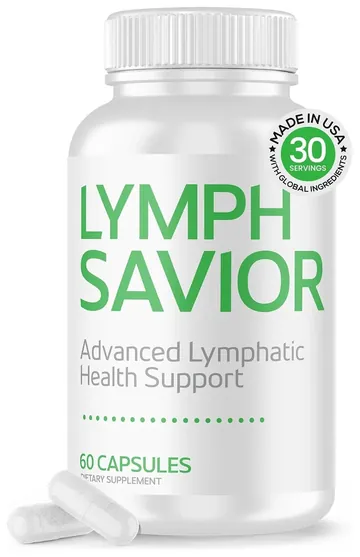
Supplement Facts
What the Lymph Savior bottle shows, the 30-serving math, and the label details still not published.
Read moreHow it works
Lymph basics in plain words, the botanical idea behind Lymph Savior, and the limits of what it can do.
Read more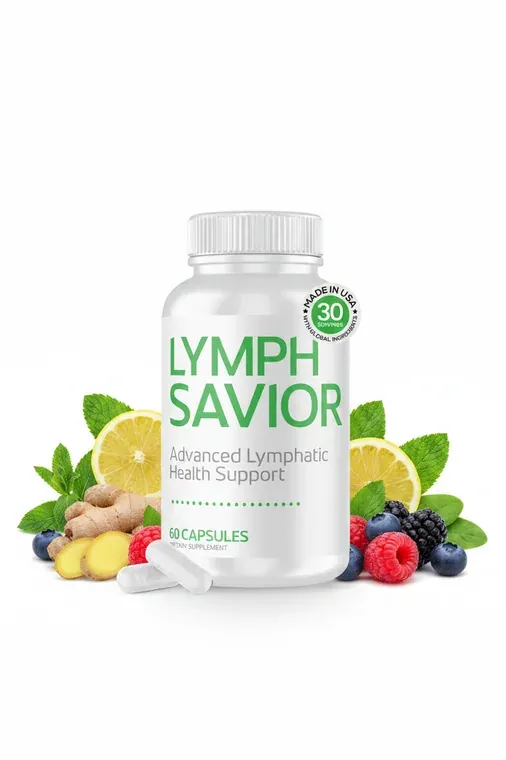
Side effects
Lymph Savior safety by ingredient: blood thinners, hormones, liver, caffeine, allergies and when swelling needs a doctor.
Read moreU.S. stocking partner for Lymph Savior
Ready to try Lymph Savior with the 60-day guarantee?
Order through the stocking partner's page so your order ID is on file with the refund desk. Prices for the 1, 2, 3 and 6-bottle packs are shown at checkout.
Questions before you buy? Call +1 (317) 715-7254. 60-day money-back guarantee, return shipping paid by the buyer.